July 15th, 2009

Debunking Yet Another Tort "Reform" Column, This Time in Forbes


I feel like a broken record sometimes, rebutting the same disingenuous tort “reform” nonsense over and over. The latest comes from Forbes (via PofL), in a piece written by Manhattan Institute fellow John Avlon, regarding the amount that New York City pays out in settlements and verdicts.

His comments in italics with my responses:

The city’s $568 million outlay in fiscal year 2008 was more than double what it spent 15 years ago.

Only double? So then, when you account for inflation, there really hasn’t been much change at all?

Sidewalk “slip-and-falls” cost taxpayers $54 million…

Sidewalk cases against the city have mostly evaporated as a result of a change in the law six years ago. In 7-210 of the Administrative Code of the City of N.Y the city shifted liability for the miserable state of our sidewalks to most of the abutting landowners.

Suing the city is big business. Ninety percent of the city’s claims costs come from personal-injury lawsuits; of these, medical-malpractice suits are by far the priciest, draining $145.3 million from city coffers in fiscal year 2008–a particular vulnerability for a self-insured city with 11 public hospitals.

Has it occurred to you that the city’s hospitals get sued often because most of them suck? If you think the city is vulnerable, what about the folks that are forced to use those hospitals? Here’s a suggestion on how to reduce city malpractice claims: Improve the hospitals. I know, it’s a crazy notion.

Nearly 90 cases against the city were settled for amounts over $1 million, and the average settlement was nearly $75,000–up from $14,396 in 1984. (The city settles most suits to reduce the costs of going to trial.)

The city settles cases when the facts warrant it. They take verdicts when the facts warrant it. The idea that the city settles a million dollar case simply to avoid the cost of trying it is empty political rhetoric that is wholly unsupported by analysis. It’s gibberish, and every medical malpractice attorney in this town knows it, defense included.

Why is Gotham such a litigation target? Blame New York State’s laws, which have made the city a gold mine for personal-injury lawyers.

Having already admitted that medical malpractice cases are the biggest problem, don’t you think you should point out that New York has some of the lowest legal fees in the nation for medical malpractice cases? Some gold mine. And perhaps one day you should look at the actual economics of taking a malpractice case in New York.

…the cozy relationship of New York trial-law firms and state lawmakers, who have received $2 million in donations over the last five years from the New York State Trial Lawyers Association.

So how much have Fortune 500 companies made in donations? Seems to me that if you want to do a comparison of donations then you need to actually have something to compare it to.

Under current law, lawyers’ fees in medical-malpractice cases are capped at 10% for all awards exceeding $1.25 million. In recent budget negotiations, Silver reportedly pushed for increasing that cap to 33%–a massive new incentive for lawsuit abuse in the Empire State

Currently, due to the low legal fees, most acts of malpractice are never put into suit. The medical community has de facto immunity from negligence in most cases. Once upon a time conservatives actually believed in personal responsibility for the conduct of people. That seems to have disappeared when it comes to protecting big business with various tort “reform” measures.

A good start would be to place caps on noneconomic damages, such as pain and suffering, as two-thirds of states have done.

Well, that would effectively make victims bear the brunt of the negligence of others. And you think that is good policy? Let the victims get poorer and the tortfeasors walk away?

In Texas, for instance, lawmakers recently imposed a $250,000 cap on noneconomic damages, which not only resulted in dramatically reduced malpractice-insurance premiums for doctors, but also cut the number of all tort lawsuits in half and doubled the number of doctors applying to practice medicine there.

To the determent of the victims. I think we can agree that when you slam the courthouse door shut in someone’s face then the wrongdoers will benefit and the victims will lose. See: Do Texas Med-Mal Damage Caps Work? (What Do You Mean By “Work?”)

But perhaps the single most effective action would be to establish a court of claims for municipal cases to restrain outsize judgments.

Interesting assumption. Some counties have become so notoriously conservative that plaintiffs no longer ask for jury trials. It’s the defendants that are making the requests. Of course, if the city attorneys appear only in front of city judges they will be able to form a more comfortable relationship with each other. Perhaps that is what you had in mind?

One last thought, if you want to “control” lawsuits; why not just abolish them and tell the victims to just piss off? Because we both know that this will be fair, make sidewalks, hospitals and cars safer, and lead to greater accountability by those that currently act negligently. Right?

Related: The False Premises of Medical Malpractice “Reform” (Response to Richard Epstein in WSJ) 6/30/09
—————————-
Elsewhere:

Reasonable people smarter than I am support the idea of reforming the tort system and limiting the rights of victims. But you have to at least pretend to write a balanced article if your are trying to convince the undecided. Otherwise, you are just preaching to the choir. [more]

  • Andrew Oh-Willeke @ Wash Park Prophet responds with Tort Suits Not What’s Wrong With NYC:

    Rather than securing and paying for medical malpractice insurance, the city’s hospital system “self-insures.” Thus, while medical malpractice insurance premiums don’t show up on the books in other jurisdictions at “lawsuit” related costs, they do in New York City…

    John P. Avlon’s … rant against New York City litigation is either fatally incompetent or dishonest. [much more here]

Links to this post:

tort suits not what’s wrong with nyc
forbes, the magazine of big business, has recently released an article arguing that new york city is unfairly subject to too many lawsuits. most of the points that it makes are convincingly rebutted here.

posted by Andrew Oh-Willeke @ July 15, 2009 8:08 PM

forbes article on lawsuits in new york
i was tempted to respond to this forbes article on how our tort system and medical malpractice lawyers are ruining new york. but, to save myself some effort, i decided to wait the obligatory fifteen minutes to give the resident new york

posted by @ July 15, 2009 12:22 PM

john avlon, “sue city”
manhattan institute senior fellow john avlon, in forbes: new york city spends more money on lawsuits than the next five largest american cities — los angeles, chicago, houston, phoenix and philadelphia — combined.
posted by Walter Olson @ July 15, 2009 9:28 AM
 

July 11th, 2009

The Summer of 1969 – A 40th Anniversary Look Back


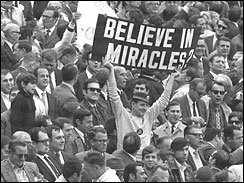
On July 16, 1969, Armstrong, Aldrin and Collins sat atop a Saturn V and blasted off to history. And our imaginations lit up regarding what was, and what could be. Woodstock and the improbable worst-to-first Amazin’ Mets followed shortly.

New York Appellate Lawyer Jay Breakstone takes a look back to the summer of ’69 today, as we take a break from posts on Judge Sotomayor…..
————————————————————-

The strong flow of events is like a river. It can carry even the most wayward leaf along for the ride. In the summer of 1969, I was surely that wayward leaf. A disastrous freshman year at an upstate New York college had uncovered two primal truths. The first, was that I was not to be a doctor like my father; the second, that you don’t take a city boy from East Flatbush and put him in a town where Andy Hardy takes Polly to the prom. I was depressed and lost, with no center to my universe and no direction known.

Enter Neil Armstrong. I had spent most of my then 18 years living with the American space program. I had dawdled in front of the TV when I should have been running to school, hoping that there wouldn’t be any holds so I could see a Mercury or Gemini launch live. Inevitably, the primitive digital clock on the screen counted down and the worst thing imaginable would occur – – the voice of Col. John “Shorty” Powers in Mission Control announcing a delay and sending me off to school unsatisfied. But as the summer of 1969 approached, I realized that all those unrequited mornings would soon be vindicated. The Russians had failed and we had succeeded. We were going to the Moon. Maybe I was mired in failure, but Neil and Buzz were not.

Somewhere along the way, though, I had decided that I didn’t want to look like Neil and Buzz. The John Glenn crew cut didn’t work for anyone other than astronauts (and those kids in that upstate town). I had attended New York City’s Stuyvesant High School, hotbed of intelligence and activism. I had marched for equality and to end the war. In a culture that still required its high school students to dress appropriately, we at Stuyvesant did not. We wore sandals (if we wore shoes at all) and carried knapsacks. Most important, we had long hair and more respect for Mark Rudd and Johnny in the basement mixing up the medicine than for Richard Nixon.

Necessarily, this caused just a bit of friction at home. My doctor father had flown B-24’s in World War II. He had that John Glenn crew cut. He believed in Vietnam because he believed in America. He was a hero. I, however, was none of these things. Moreover, I had just demonstrated that I was not much of a student either. We talked a lot that summer of ’69 and, like a huge ocean liner, my father began a slow turn. Vietnam ceased to make sense to him and Woodstock suggested that perhaps his son might have a different way of looking at the world that was not quite as foolish as he had once believed. If there is a time for every purpose under heaven, that summer allowed me to ride the good vibrations of Woodstock into my father’s heart, a place where I had never really left in the first place.

The pulse of the times can substitute for the vitality of the individual. All you have to do is be clever enough to hop on board. The summer of 1969 was a veritable freight train of optimism. We could stand on the Sea of Tranquility and we could stand in the mud of Max Yasgur’s farm. It was all good. A small town college could give way to a large city university. Science and math could surrender to writing and literature. The dream of medical school could disappear and be replaced by “maybe I’ll go to law school.” In the summer of 1969, anything was possible. How did I know? Because the New York Mets were on their way to the World Series.

My life then had been short, but not so short that I hadn’t sat in the stands of the Polo Grounds in 1962, where the woeful Mets played before Shea was built, wondering whether anyone on my team could play this game. Off in the distance, beyond the hills of Coogan’s Bluff, sat the Palace of the Hated, Yankee Stadium. There, a real baseball team played. To them, it wasn’t a game. Baseball was serious business there. Tell that to Marv Throneberry, my first baseman, who made every pop fly a cosmic experience. Would the gods let Marv catch it or wouldn’t they? It seemed to have nothing to do with Marv. I was born and bred in Brooklyn. My mother had been a crazed Dodger fan, so much so that my Bronx-born father was never permitted to say the “Y” word in our house. By the time I was old enough to go to a ballgame, my team had left for California. I was rudderless on the sea of sports fandom. My early years were taken up by watching roller derby instead.

In that summer of 1969, however, anything was possible. I sat in the old Dodger Bar and Grill on the corner of Flatbush and Fulton, watching the games on the color television propped high in the corner. It was hot that year and the coolness of the dark bar calmed me. So did the cheap beer on tap. I sat and tried to figure out what to do with my life and watched the Mets do the impossible with theirs. Me, the Mets and three old guys who had not left that bar since the Dodgers won the World Series in 1955. They had waited in that very bar since then for the lightning to strike again. They had grown old waiting. Their families had lost track of them; written them off as dead. Detectives had closed Missing Persons files and shelved the boxes in closets marked “Unsolved.” Yet, here they were, like Macbeth’s three witches. For all those years they had been conjuring, stirring their Four Roses with a Rheingold back, invoking the baseball gods. In the summer of ’69, when anything was possible, it happened.

I know that these things happened, because I was there. In the summer of 1969, I was born again. I floated along on that river of the impossible and let it take me where I didn’t have the strength to go by myself. We kept going back to the Moon, the Mets won the World Series and even the Jets won the Super Bowl. Woodstock became synonymous with a better place where better people lived a better idea. I guess I was lucky. The time warp had opened, but only for a moment. God had smiled for an instant. Within a year, it would all be over. There would be four dead in Ohio, my mother would tell me that I shouldn’t worry about the draft because she wasn’t letting me go anyway, and my father would be dead. Oh, and I would be well on my way to law school, but I didn’t know that at the time either.

———————————————————————–
Jay Breakstone did, indeed, make it to law school, and was sworn in eight years after this legendary summer. His current email is NYAppeals [at] gmail [dot] com.


July 10th, 2009

Linkworthy (Double Edition)


Sarah Palin rants against frivolous ethics complaints. Then threatens her own frivolous action, for defamation. (PopTort, Turley, Sugerman);

Roy Mura celebrates 500 posts over at Coverage Counsel;

A million bucks for an ankle fracture? John Hochfelder describes how that happened;

Kevin, MD. asks: Did propofol, or Diprivan, kill Michael Jackson? And a slew of commenters add their two cents;

The Namby Pamby Attorney is proposing new legislation: The title of this act is “The Pedestrian Commuter Protection Act” (This act may also be referred to as “Move Bitch, Get Out Da Way”). Proceed with caution;

From Carolyn Elefant: If bloggers must disclose, why shouldn’t bar associations?

New York City gets attacked by turtles. Yes, turtles, that is not a typo (NYT, City Room);

But that’s not as odd as Batman and Superman getting arrested in Times Square for wearing their costumes. Really. And the Man of Steel didn’t take kindly to it, either. (NY Mag, Intel)

Max Kennerly has a story that looks like it was written 50 years ago, but wasn’t: Philadelphia Swim Club Refuses Black Children Because Of Their “Complexion” (with a follow-up today);

Ron Miller with a great collection of links for the July 4th weekend;

TortsProf with a personal injury law round-up, also July 4th edition;

Last week, Adrian Dayton did his ode to Twitter in Blawg Review #218 (though I’m not a fan of the service, as I said both before and after I tried it);

This week Cathy Gillis rocks ‘n rolls through Blawg Review #219;

And if you’d like to have your own post considered for Blawg Review, Walter Olson is writing next week’s Blawg Review #220, fresh on the heels of his 10th anniversary as a blogger. He has the details at Overlawyered.


July 9th, 2009

Prior Sotomayor Document Says "Sotomayor & Associates" Was NOT Law Related — Updated


The mystery surrounding “Sotomayor & Associates” gets curiouser and curiouser. Still trying to figure out exactly what Judge Sotomayor was doing with this firm she ran from her home between 1983-1986, I dug into her questionnaire from her 1997 appointment to the Second Circuit, now available at the Clinton Library. (Box 0001, Folder 00003)

In that document, she gives her non-judicial legal experience as a state prosecutor (August, 1979 to March 1984) and as a civil litigator at Pavia & Harcourt (April 1984 – October 1992). There is no mention of a solo practice law firm under the name “Sotomayor & Associates.” (See question 10, page 4).

But then she adds in “Sotomayor & Associates” in response to a request for non-legal positions (Page 8, paragraph 16):

Have you ever been engaged in any occupation, business or profession other than the practice of law or holding judicial or public office? If so, give details, including dates.

No, except advising and consulting family and friends as Sotomayor & Associates from 1983 to 1986.

So, was this a law related business as indicated in her SCOTUS questionnaire (p. 143) or a non-law business as set forth in her 2nd Circuit questionnaire?

And why aren’t the answers consistent (especially for someone described as “meticulous”)?

This little research project of mine, by the way, stems from little more than wanting to know what kinds of clients she had represented in private practice. Basically, I wanted to know if they were large corporations or regular people. I had discussed this a bit prior to Sotomayor’s nomination in The SCOTUS Nominee and the Tissue Box Test.

But every time I take a peak at something related to “Sotomayor & Associates” I seem to end out with more questions than answers.

Updated: The New York Times now has dug up documents from Judge Sotomayor’s 1991 appointment to the District Court that gives more regarding “Sotomayor & Associates,” which appears contrary to the way the White House was downplaying it. The Times article says:

But documents released by the library of former President George H. W. Bush this week give the sense that White House, in 1991, when Judge Sotomayor was 37 years old, had a more formal view of the law practice as administration officials in Washington considered her nomination to the federal bench that year. [More at this link]

Links to this post:

blawg review #220
welcome to blawg review #220, rounding up some highlights of the past week from around the legal blogosphere. it’s my second time hosting it here at overlawyered, a blog that as its name implies maintains a certain critical distance
posted by Walter Olson @ July 13, 2009 3:40 AM


July 9th, 2009

"Sotomayor & Associates" Under Senate Investigation ( A preview of 6 potential issues)

I was called yesterday by a member of the Senate Judiciary Committee’s minority’s legal staff regarding my postings on “Sotomayor & Associates” and potential ethics issues, and the subsequent New York Times article regarding the firm.

It probably comes as no surprise that Judge Sonia Sotomayor’s small, solo practice is being investigated. The committee is not, after all, a potted plant. And this little law firm that Judge Sotomayor ran out of her Brooklyn home from 1983-1986 was unknown to the world until she submitted answers to an extensive questionnaire on June 4th.

What follows are the five issues that I believe they are exploring, based upon my conversation (plus one more from TaxProf), as well as some thoughts on why these items may well be the focus of some questions despite other matters being significantly more important:

1. Was she permitted by the District Attorney’s office to have a side practice while still an ADA? In the Times article, long-time New York DA Robert Morgenthau said yes, though others have said no.

2. Did her new firm Pavia & Harcourt permit its lawyers to have an outside practice? As per the Times:

“It is news to me,” Mr. Pavia said. He said she likely cleared the outside work with her direct supervisor, who is now dead.

3. Did Judge Sotomayor run her private clients’ matters through the conflicts department of the new firm (or of the DA’s office, while she was still there)? Even a simple house closing with a mortgage could conceivably be an issue if the DA or the firm had matters regarding the lending institution. A conflict check might be needed. While her direct supervisor at Pavia may have passed on, one would assume there would be a record of potential conflicts submissions if the firm was of any great size at the time.

4. Sotomayor & Associates was a clearly misleading name since there were no associates. Will this matter? If she never had stationery, and simply put the name on her tax returns as the NYT article suggests, it is likely moot. But if she did have stationary of any kind, it is an issue of minor interest. It’s a minor interest, of course, only if she admits to having screwed up. But she’ll get kicked around but good if she had letterhead and tries to claim (as the White House has suggested) that the ethics opinion forbidding such conduct was only “advisory.”

5. Was Sotomayor & Associates registered with New York’s Office of Court Administration? This is a mandatory periodic filing for all attorneys in the state. The Times wrote the following on the subject, but I believe they were wrong on the requirement:

She never incorporated Sotomayor & Associates or registered it as a business in Manhattan or Brooklyn, where she then lived, according to public records, though she was not required to do so.

In fact, it appears that attorneys were required to register with the Office of Court Administration, unless there was a rule change during those years. The registration form used today requires the name and addresses (plural on the form) of the law offices be given to our court administrators every two years. It reads as follows:

(e) The registration statement shall be on a form provided by the Chief Administrator and shall include the following information, attested to by affirmation:

(1) name of attorney; (2) date of birth; (3) name when admitted to the bar; (4) law school from which degree granted; (5) year admitted to the bar; (6) judicial department of admission to the bar; (7) office addresses (including department); (8) home address; (9) business telephone number; and (10) social security number.

Is there a difference between the forms used today and those used back then? Yes. Now there is more information required. But the requirement for all addresses is apparently the same.

How do I know what the mid-80’s rule was? Because I pulled out my own registration form, which has an effective date of January 1, 1986. I saved everything regarding my admission because my bar exam results from the summer of 1985 had been infamously lost, making me a tad neurotic on the subject.

So unless there was a change in that particular rule from 1983 to 1986 — and this is possible since my form was dated 1/86 indicating that something changed; you can see the back of the form here: /OCA-Reg-Form1986.pdf — Judge Sotomayor messed up her registration requirements. What does that mean? Here you go:

Failure by any attorney to comply with the provisions of this section shall result in referral for disciplinary action by the Appellate Division of the Supreme Court pursuant to section 90 of the Judiciary Law.

It therefore seems possible, unless there was a change in the rules from 1983-1986, that Judge Sotomayor was practicing law out of her home without being properly registered there. While that would be wrong, it isn’t a particularly big deal if she was registered elsewhere and her registration fee paid, as was no doubt the case. You need to do a helluva lot more than that to get in trouble.

But Judge Sotomayor should nevertheless be prepared to answer that question about the lack of proper registration. This is especially true since the Times article appears to have made an error regarding the necessity of registration. I suspect that error was based on information that came from the White House or the expert they retained to review the whole Sotomayor & Associates thing. (Alternatively, I’m wrong and there was a change in that narrow window of time.)

We have, therefore, a smattering of small issues. But small errors can become bigger ones when people try to fight them instead of simply acknowledging obvious mistakes. Given the lousy defense previously offered from the White House’s designated expert on the subject of “& Associates,” there is reason to be concerned.

So why is her moonlighting solo practice important? Because her extensive legal background is, from the standpoint of most of the Senators’ constituents, a morass of legal nuances that lawyers love to debate but which the rest of the public is generally ill-equipped to quickly digest (summary here). But easy ethical issues like those mentioned above work well in a televised setting. And that makes it fodder for high-profile hearings where camera-hungry politicians hope to poke and prod and score the best quotes for the evening news.

In sum, Judge Sotomayor should be prepared to use the phrase, “I messed up,” instead of “There was no controlling legal authority” to avoid these issues. And if she is as “wise” as she says she is, that is what she will do.
————————–
Elsewhere is item #6: At Paul Caron‘s TaxProf, guest blogger Linda Galler speculates that the law practice might have simply existed so that a home office could be written off on the tax returns.

Links to this post:

blawg review #220
welcome to blawg review #220, rounding up some highlights of the past week from around the legal blogosphere. it’s my second time hosting it here at overlawyered, a blog that as its name implies maintains a certain critical distance

posted by Walter Olson @ July 13, 2009 3:40 AM

why eric turkewitz still matters
with regard to the issue of giving credit for discovering the “sotomeyor & associates” issue, eric turkewitz comments: something might be in the public domain, but it if is buried in a box of other documents, someone still has to go
posted by Mark Draughn @ July 09, 2009 11:48 AM