May 9th, 2012

Study Says Texas Medical Malpractice Tort “Reform” Is A Bust (Is Congress Listening?)

I’ve written before about the savage Texas medical malpractice “reform” that was implemented in 2003 and its inherent injustice. The premise was that if the state capped pain and suffering awards at $250,000 for doctors (no matter how many were liable) and $250,000 for hospitals, it would encourage more doctors to practice medicine in Texas. The cap was nominal, meaning it was not adjusted for inflation, so it remains at that stagnated level.

Now there is a study that debunks the premise of that so-called reform. And even tort “reformer” Ted Frank agrees that the report is so damning that he will no longer cite Texas for the proposition that such reforms will lead to an increase in doctors in the state.

The report is exceptionally damning to those who argued that providing protections and immunities to negligent doctors would bring more doctors to Texas (though I’ve often wondered what kind of doctors they were looking to bring in with that logic). The summary:

Before Texas adopted tort reform in 2003, proponents claimed that physicians were deserting Texas in droves. After tort reform was enacted, proponents claimed there had been a dramatic increase in physicians moving to Texas due to the improved liability climate. We find no evidence to support either claim.

That is a big, fat ouch for those that have supported government protections for tortfeasors.

The $250,000 cap that was enacted back in 2003 did have some affect, of course. It cut down medical malpractice payments by 70% and premiums by 50%. But this wasn’t the reason for the changes in the law, since claim payouts had been stable for the preceding decade. But claims will clearly drop under such circumstances as cases are difficult and expensive to bring, and if it isn’t a economically viable to bring the suits, lawyers won’t take them. It isn’t easy to risk tens of thousands of dollars of your own money and hundreds of hours over many years if the case isn’t substantial enough. The rent still has to get paid, as does the secretary, and the lights need to be kept on.

But did the 70% drop in payouts bring the flood of doctors? You would think so according to the initial reports (including from the New York Times) that looked at the increase in licenses being issued. According to the report:

Proponents argued that physicians were fleeing Texas because of lawsuit risk and high insurance premiums, but would stop leaving if the state adopted the reforms. After the reforms took effect proponents asserted that the reforms brought new physicians to the state in droves – a more impressive result than they originally predicted, which was only that doctors already in Texas would stay put.

But using data from 2003 up until 2010, the authors conclude:

There is no evidence that the number of physicians per capita practicing in Texas is larger than it would have been without tort reform.

The evidence has been brewing. In 2007, four years after reform, the Texas Observer ran a piece discussing the nonsense that was sold to voters by the insurance industry to get the bill passed, claiming that “doctors were fleeing Texas, leaving scores of counties with no obstetricians to deliver babies, no neurologists or orthopedic surgeons to tend to the ill.” This wasn’t true.

Also from the Observer, to get that bill passed Gov. Rick Perry and his minions from the Texas Medical Association argued in a flier mailed out in English and Spanish and posted in waiting rooms around the state that:

‘152 counties in Texas now have no obstetrician. Wide swaths of Texas have no neurosurgeon or orthopedic surgeon. … The primary culprit for this crisis is an explosion in awards for non-economic (pain and suffering) damages in liability lawsuits.’

Doctors to deliver your babies or lawsuits, they argued, which would you like? And you know what? Four years after the “reforms” were passed there were still 152 rural counties without an obstetrician. Because it seems that doctors, like many other professionals, happen to like living in urban areas.

The reports of an increase in doctors attributable to tort “reform” that came out, and are often echoed in Congress by advocates of establishing federal standards over the state tort systems, have not been accurate. The authors attribute this to the fact that the number of doctors going to Texas was rising before 2003 (as was the population as a whole), that researchers at universities should not be counted as they are unaffected by the issue, and that there was an increase in medical care after Hurricane Katrina in 2005 as people relocated.

And finally, the statistics showing an increase in doctors was based on new licenses being issued. But that didn’t take into account those that left the state or had retired. You can’t just count docs entering Texas healthcare without also accounting for exiting docs if you want to figure out whether the net population is increasing or decreasing. According to the authors, “using the number of licenses granted as a measure of the “success” of tort reform is potentially very misleading.”

The fact that the physician population was increasing before the “reforms” and continued to increase at the same rate after the “reforms” is very telling. The authors write, “There was neither an exodus before reform, nor a dramatic increase after reform.” How damning is this report? The authors go on to write about those who made the claims for “reform”:

When making the case for lawsuit restrictions and when claiming enormous post-reform success, the identified speakers made statements that were false. And, not just garden variety false, but “liar, liar, pants on fire” false.

And that my friends, is a whole lot of false.

The report is filled with facts and figures that shows that in the post-reform era, Texas has actually done worse at attracting doctors then the rest of the nation. Not better. And not even the same.

I end on this note: As I type, Republicans in Congress (it is always those that claim they want limited government that do this) seek to expand federal power and put nationwide damage caps in place. One of the prime reasons is that were used in Texas. And those that were used in Texas have now been debunked.

(P.S.   For those that want to shift the argument to arguing that such reforms will lower health care costs, well, it doesn’t do that either. I covered that last year here:  The Failure of Medical Malpractice Caps (Healthcare Costs Rise in Texas).

Elsewhere:

New Study Crushes Key Claim in Federal Medmal Debate (Andrew Cochran)

Did You Know… Medical Malpractice Lawsuits Are Declining? (Brett Emison)



May 9th, 2012

Disconnected from my Self Phone

I lost my phone two weeks ago.  In an age of instant communications, that had the potential for anxiety and crisis. Since it was an iPhone, it also cut me off from instant email, texts, sports scores and Googling to settle friendly bets. You know, the important stuff.

But I probably didn’t miss too many incoming calls, as I don’t readily give out the number to too many. I don’t want to be reached at an instant’s notice by anyone.

When I tried to replace it with a gently used phone bought on eBay (my contract wasn’t up, and I would have to pay full freight for a new one), that phone never arrived in my office. So the seller replaced it. Hence, a two week hiatus.

I’m back up and running again, but I lost nothing of value. In fact, my semi-vacation from instantaneous connectivity was quite nice, and I may simply opt to leave that phone in the off position sometimes. Just because. Is that much that we really need to have at our fingertips?

One additional benefit, when talking about the lost cell phone my son referred to it as a “self phone.” Having never actually seen the spelling in print it was an easy error, but a phrase that happens to be dead on target. The Urban Dictionary refers to it as a phrase for calling oneself, after presumably mis-placing the phone somewhere. But I like my son’s definition better. The self phone is my phone.

And now that I have a new one I can use it for its most useful purpose: Letting my wife know which train I’m on as I head home.


May 3rd, 2012

The Chinese Dissident, George Zimmerman, Bernhard Goetz, and Jury Selection

It happens time again like clockwork. An item appears in the press, and the facts behind the story are not clear. And yet people leap up to take passionate stands on the issue. Since the desire of some people to leap to conclusions is also important for jury selection, a short look at three high-profile incidents is worth exploring.

Item 1 comes from 1984 when white New Yorker Bernhard Goetz is approached by four black teens on the subway asking for money, while one of them wields a screwdriver. (The wielding of screwdrivers as a threat was an item in the press, not an actual fact of what happened.)  Goetz whips out a revolver and guns them down, seriously injuring all four. In a high-profile attempted murder case he asserted self-defense in an attempted mugging. The four teens claimed they were panhandling. Goetz was acquitted of all charges except the one for an unlicensed handgun.

But the one thing that really stands out in my mind 28 years later are the television images of the protesters outside the courthouse. Some screaming he was a racist vigilante that should be found guilty and some screaming he was merely defending himself and should be acquitted. These protesters shared things in common, besides the screaming: None of them actually saw what happened and none of them were listening to the evidence in the courtroom. They found their opinions based on what was already in their hearts and the information they cherry-picked from conflicting news accounts — some not even accurate, like the screwdrivers which the shooting victims had in their possession, but did not use in this incident.

Fast forward to Item 2, the shooting death of Trayvon Martin by George Zimmerman. In an eerie flashback to Goetz, we see people once again vaulting their way to opinions based on incomplete stories in the press. People take passionate sides on an incident where they are privvy to, at best, fragmented facts.

And right on the heels of Item 2, we go to today’s story of Chinese activist Chen Guangcheng who fled  house arrest to take refuge in the U.S. embassy. After the diplomatic two-step he was released with various promises, including staying in China safely. But right after his release into a hospital came stories that he wanted to leave China.

Once again we will see people leaping to take sides, this time in the political arena where spin is more important than facts. Because facts, in this case, are largely in the secretive hands of the diplomats involved. But that will not stop the leap of faith to criticism (or support) for the actions of the diplomats.

We see people like this in our everyday lives, the types that form opinions based on headlines instead of facts. Identifying such people in the speed-work of jury selection is the hard part, because these are the people who will decide cases before the facts are all in.

I have no easy answers as to how to accomplish that, as often we are left with just minutes per juror. But the time-tested advice of many to ask open-ended questions is one way to help ferret out the attitudes. Asking people “How do you feel about …” is more effective in eliciting valuable information than trying to indoctrinate them by asking them to agree/disagree with certain points. The more people talk, the better chance they will reveal something about their opinions and attitudes that might actually be useful in determining if they can sit fairly.


April 26th, 2012

Money, Money, Money

♫ ♪ Money makes the world go around, the world go round, the world go around ♪ ♫

I don’t usually write about BigLaw stuff, but money matters to SmallLaw also.  Today we’ll look at one BigLaw money story and one SmallLaw legal decision that just came out, and why they both matter.

In the world of Big, Dewey LeBoeuf appears to be imploding because they are deeply in hock to the banks. Why? Due to an exodus of about 70 partners, apparently leaving it close to breaching its loan covenants with the bank.

The problem is that law is not just law, but it’s a business. A business that needs cash to operate. And that cash must come from somewhere.  If the firm uses hourly  billing, the work gets done and the bills go out and then some months after the work is done the money comes in. Hopefully. But in the meantime, the rent must be paid, the secretaries must be paid, the lights need to stay on and the lawyers still need to eat.

It’s a simple of matter of cash flow and the delay between work getting done and cash coming in.

Which brings me to small law. The solos and small firms face the same problem but on a different scale. With a bare bones operation doing contract work for others the issue might not be quite so readily apparent.

Now what happens if business starts coming to the lawyer directly? For some cases a retainer might be taken up front, which is the way many criminal defense attorneys operate. Of course, if you don’t take enough and make an appearance in court, you might find yourself in trouble later when “the rest of the money” fails to come in and the judge won’t let you out of the case.

But the biggest problem is in the personal injury field, where work is done (often for years) without getting paid. Worse yet, the lawyer is expected to finance the case for the clients who, more often than not, would be unable to do so on their own and thereby unable to bring the case.  Even smaller cases can rack up an easy $20,000 in expenses  before a trial even takes place, when you factor in the medical records, reports, experts and depositions.

There are some lawyers, not really thinking about the issue, who pine for a few personal injury cases, not appreciating the fact that a flood of business also means a flood of financial anxiety.

And so lawyers — not just the BigLaw kind but the SmallLaw kind — need financing. This can come from banks, most preferably, or from personal assets, if you have them. It can also from vulture financiers that specialize in this field and charge absurd interest rates.

The vulture companies are a business that “invests” in a case. If the case is lost, they don’t (theoretically) get paid, meaning it isn’t a loan and they can charge interest rates in excess of usury laws. Justice Pines out in Suffolk County wrote about this issue a month ago in Kelly, Grossman & Flanagan v. Quick Cash, laying out all the gory details. This includes the idea that if a case is lost, the lawyer must replace it with another case.  When the borrowing lawyers tried to get the agreements declared to be criminally usurious, it didn’t go so well.

Now this is the part that’s important: The time to think about that financing is not when you need the money, but when you don’t. If you wait until you are financially strapped and then go to the bank and ask for a line of credit, they will see your financial distress. And — this comes as a surprise to many — banks don’t want to lend money to people who really need it. They want to lend the money to those who look comfy and safe. Because the bank would like to get its money  back one day with a little interest. I learned this one the hard way many, many years ago when I was a puppy lawyer.

The time to open that line of credit is: As soon as possible. This is true especially if you don’t need it. Because if you have any success at all as an attorney, one day you will. So open the line, and get occassional increases in it. Five years down the road when the money is truly needed, you’ll be ready.

The last thing a lawyer wants is to be desperate for money.That causes bad legal decisions.  All of a sudden you might find yourself thinking that that  auto case you took in three years ago and worked your butt off on and which you think your client should be entitled to the full 250K in insurance that is available, might be the one to settle now for the 100K offer. And you don’t want to be that lawyer. Ever.

♫ ♪ Money makes the world go around, the world go round, the world go around ♪ ♫


April 17th, 2012

The Boston Marathon (Highway to Hell)

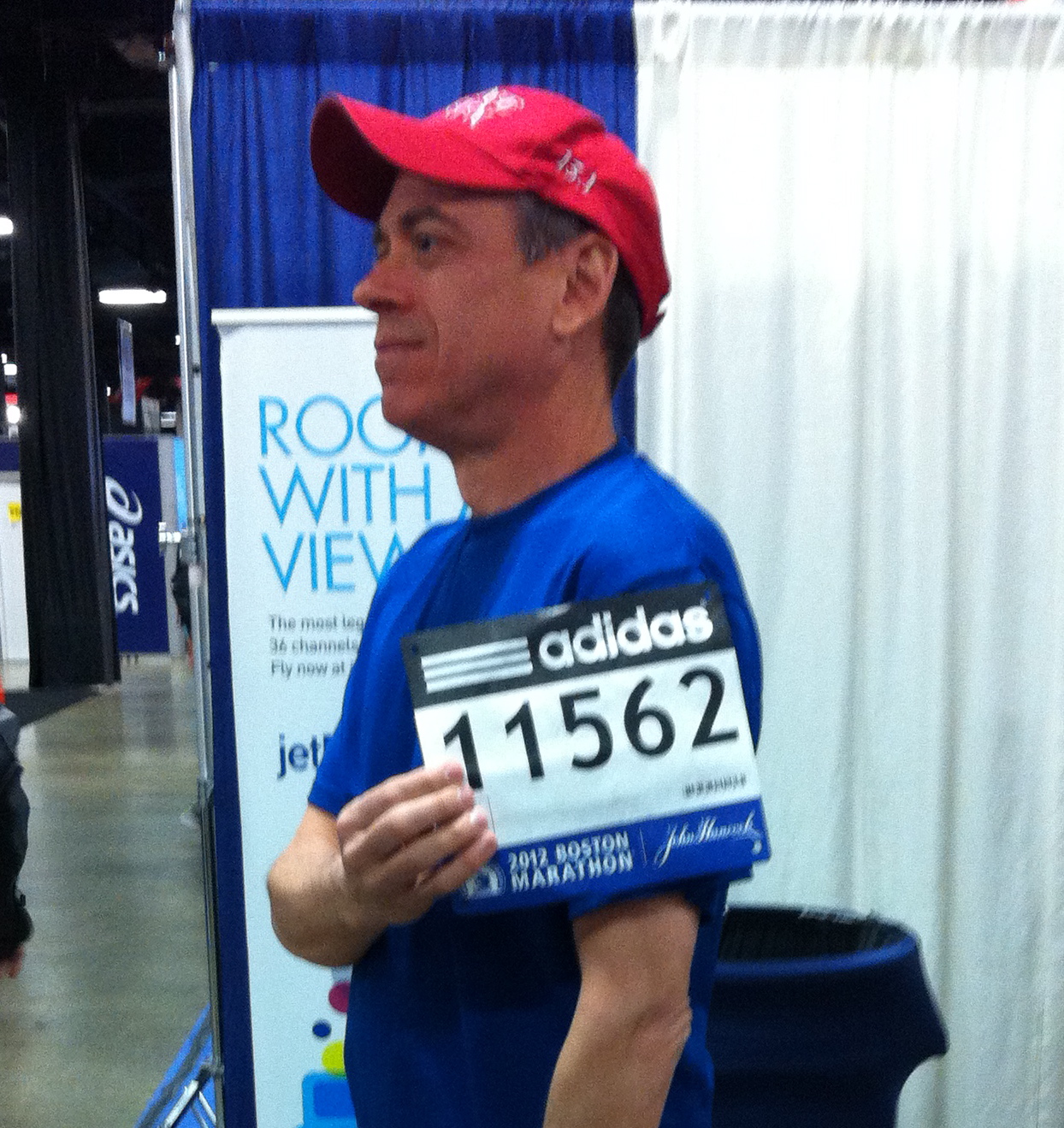
Pre race mug shot - because I needed a legal angle for the blog

Yeah, it was hot out there. The average temperature for Boston this time of year is 47 degrees. And runners favor such races with temps in the high 40s – low 50s.

The temperature yesterday, however, was 87 degrees at the finish line for the 116th running of the Boston Marathon for those of us in the middle of the pack. Elsewhere it was reported to have hit 89. And that, my friends, is a whole lot of hot.

When I first wrote about the Boston Marathon in 2007 I did so to wish others well as I pined to one day run fast enough to earn my entry ticket. And when I wrote  a second time in 2009, I told my story of personal redemption after having finally qualified and run.

But this was not about redemption, or pining. There would be no eyes toward personal  bests, or running fast enough to qualify for another Boston. This was, quite simply, the meteorological luck of the draw. People had trained for months on end, had made their plans, and travelled great distances to run the premier marathon in the world that is open to amateurs.  Because after Boston in the pecking order, there is only the Olympic Trials.

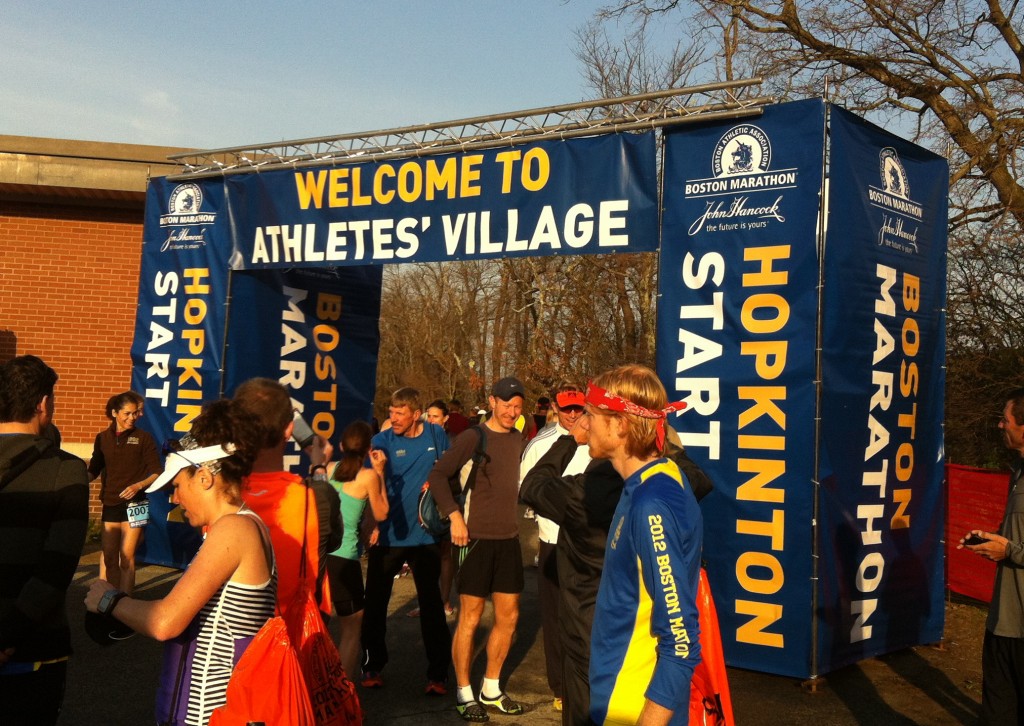
And so we went, with runners going off in three waves out of the rural suburb of Hopkinton at 10:00, 10:20 and 10:40 as the the thermometer soared up to 80. Very few took up the offer of deferring until next year. There were two rules of thumb: Drink a lot and adjust your running plan, or  you would not see the finish line.

While I don’t usually take walk breaks in marathons, I knew this would be an exception. But I didn’t expect that I would take the first one after just four miles. Four miles?

And I took them every mile thereafter except for one (the last mile, which I refused to walk). I wasn’t alone, and knew if I didn’t start re-charging my batteries with those walks early on I was a candidate for the medical tent.

The odd thing about this race is that there was no sweet spot. No time to simply cruise. For most people that run this distance the first few miles are just to shake out the legs and anxiety. Miles 4-16 should be the comfort zone. Those moments never happened.

Brutal was the word for the day. When the sun disappeared for 30 seconds behind the sole cloud in the sky, a roar went up from runners and spectators alike that rippled down the course. Early on I  heard the refrain from Highway to Hell blaring from speakers. There was nothing to do but laugh.

Photo credit: Lorianne DiSabato on Flikr

The crowds were nothing less than awesome and the water sprays were out in force – firemen with hydrant attachments, homeowners with hoses, kids with spray guns.

Since the early running goes through so many small towns — Ashland, Framingham, Natick, Wellesely and Newton — before hitting the big city, the route is a constant stream of homes and villages with local parties along the way. With 500,000 spectators, this is the the biggest event in New England. And the locals were doing what they could for us. Passing out water, passing out oranges, passing out support and passing out beer. And yes, you’re damn right I took some beer. It fortified me for Heartbreak Hill, part of the hills of Newton between miles 17 and 21.

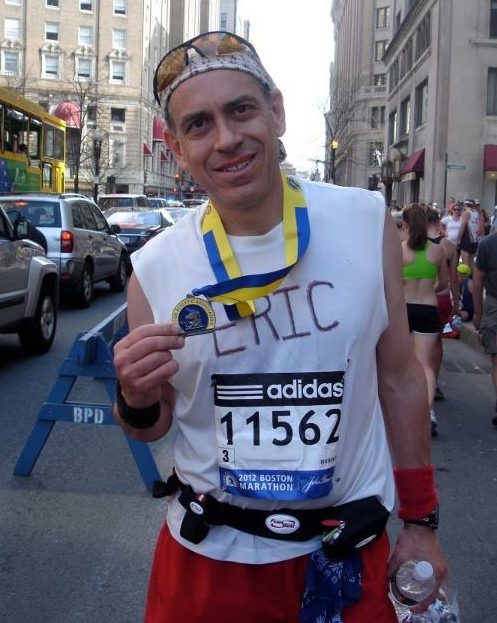
It was during those walk breaks that the crowd really played a part, as I had written my name on my shirt. This is a twofer: The crowds love knowing who is in front of them and the runner gets support. So when I was walking, the chanting would start. Sometimes solo, but sometimes large groups urging me on. And that helped snap me out of some of the longer walk breaks deep into the race.

The view of the other runners in those late stages brought to mind images of refugees trudging toward safety. I saw more people walking up Heartbreak than running it, moving forward, forward, inexorably forward.

From today’s New York Times came this interview using the word of the day:

“This was the toughest marathon I’ve ever run, and I’ve done 5 Ironmans, 3 Bostons and about 20 marathons,” said Mark Williams, 45, of Richmond, Va. He said his time was 30 minutes slower than six months ago. “It was brutal.”

And this from Jason Argent on Twitter:

My 5th #BostonMarathon a brutally rough go in 90 degree temps. 45 mins off my time last yr. Just happy to be alive after that death march.

One of the problems the race organizers had was not knowing exactly how runners would handle the heat. There isn’t a lot of real-world data on the subject of running 26 miles in those temps. One striking example was the 2007 Chicago Marathon that was cancelled mid-race due to heat, when water stops ran out of the precious liquid. (Many early runners were grabbing two or three cups and dowsing themselves, leaving the back of the pack without.) I carried backup of fluids yesterday, just in case. But water seemed plentiful, at least from my middle-of-the-pack vantage point, and I drank so much Gatorade I felt like I was being prepped for a colonoscopy.

When I did hit the finish on Boylston Street in Boston’s Back Bay section I came in about 30-35 minutes off my expected finish time. But I wasn’t disappointed, as others did the same. Adding 30-45 minutes was normal according to most people I spoke to, and that includes top local runners capable of cracking three hours in average conditions.

Few runners train in such heat. Even those in hot weather climates like Florida or Arizona are likely to train early in the morning or after the sun goes down. But mid-day, with no time to acclimate to these temperatures because this is a spring marathon and not a fall race? To quote Donald Rumsfeld:

There are known knowns. These are things we know that we know. There are known unknowns. That is to say, there are things that we know we don’t know. But there are also unknown unknowns. There are things we don’t know we don’t know.

And one thing the vast, vast majority of runners didn’t know was how we would handle the heat. It turned out that there were 2,100 runners treated for dehydration out of 22,000 starters.  As for the other 90% wondering if would could handle the heat: We can, and we did. But we might not be too keen on repeating the adventure.


And now the legal part of this post. (I have to have one, don’t I?) When athletes toe the starting line of an event, they assume the risks of competing. And that includes dealing with the weather.

My finishers medal will now be placed in a prominent spot in my trophy room. Also known as the tie rack in my closet.

For those with an interest in running and the law, once upon a time I did a Blawg Review based on the NYC Marathon.

Lastly, for those who ran Boston yesterday, this video’s for you.

My legal posts can be followed with my Twitter handle @Turkewitz, but for the running, it’s @PaineToPain.

Elsewhere:

Surviving the Boston Marathon (The New Yorker)

Boston Marathon Deferrals: Here Are the Facts (Runners World)

Boston Marathon a Battle, from Start to Finish (Tom Renner)

…Nothing in my running bag of tricks – energy gels, water, Gatorade, alternating walking and running – seemed to do much good.  The temptation to walk off crossed my mind frequently… [more at link]

Boston Marathon 2012: Mile by Mile (Mile Posts by Dorothy Beal):

You don’t hit the wall at the 8 mile mark. I knew it was the heat….Mile 21 was my first mile in the 10′s. I’m not sure the last time I saw a number in the 10′s…By Mile 23 I had started vomiting….[more at link]

RACE REPORT: Brian Adkins Finishes 2012 Boston Marathon (Marathon Brian):

…I had finished the 2012 Boston Marathon, 41 minutes slower than 2011′s performance in my first Boston run, but probably my proudest day as an athlete and event competitor….

The Boston Marathon: A Recap (I Dabble):

It was my slowest marathon to date, but is easily the one I am most proud of.

Boston 2012: The Hot One (Apple Crumbles):

…At 10K, people were already struggling. I wasn’t alone….

Race Report: Boston Marathon (Will Run for Beer):

…when I wrote on Sunday night of my revised goals for the race, I still thought I’d run a 3:20 and then come back here and be all “that was hard, but if you trust your training, you can do it.”

Instead I ran a 3:50 and honest to God considered dropping out. Of the Boston Marathon.

Lest you be wondering if the heat was really that big a deal, it was…

Too Hot to Handle: Boston Marathon Race Report (Runnrgirl’s Blog):

The first 3 miles …so i was bouncing along, pretty content for a while, and then i started feeling nauseous. i’ve battled nausea while running before so i thought it was still nerves and it would shake out as my body got used to running…the nausea led to some dry-heaving…

Boston Marathon Recap (linseyontherun):

I planned to crush the marathon.  I aimed to run my best marathon by far, shooting for a goal between 3:15 and 3:18.  That didn’t happen and normally, I’d look back on this marathon and be devastated.  This year, I feel accomplished and am still in a bit of shock over how I persevered and made it to the finish line.

Baked in Boston (Sweet Victory):

Obsessions over my pace were replaced by obsessions over the ice bags and sprinklers that the fans of Boston had all over the course. I’d heard it before and now I know it’s true: these are the best marathon fans in the world. I ran from ice bag to ice bag, through sprinklers and hoses, doing everything possible to keep my core cool…

My Boston Marathon Lesson: Remember the Goal (Dan Taylor):

I finished my first Boston Marathon yesterday and want to capture the most important lesson I learned from that experience.

Although I learned the lesson in the excruciating heat of the Boston Marathon I know for me it’s a lesson that I’ll carry over into other parts of my life…

What NOT Running the Boston Marathon Taught Me (Run Brit Run):

Not running on Monday was one of the hardest decisions I’ve ever had to make. For 5 months, my life was training for Boston. Everything I did was planned around training runs. I barely went out, I spent an abnormal amount of time with my foam roller, and when people asked what my weekend plans were the response was always how long my long run was that week. Giving up the culmination of all of that hard work crushed me….

xx will update with good blogs posts as they are found xx