August 16th, 2012

Gordon Gekko, HCA and Lawsuits (Why are medical costs going up?)

Greed is good. So says Gordon Gekko in the movie Wall Street. But is it the greed of medical professionals, or fear of lawsuits and the practice of “defensive medicine” that drives up medical costs?

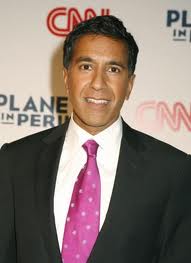
The other day I responded to Dr. Sanjay Gupta’s op-ed in the New York Times on the related subject of more medical mistakes occurring because of unnecessary medical testing. And in that piece, and the part that spurred me to write, he claimed that defensive medicine was at fault.

This, of course, was dead wrong and has been disproved with empirical evidence.

But in doing that piece, I postulated three reasons why medical costs go up. The first one was deeply cynical:

  1. Doctors get reimbursed for each test they do, so there is a financial interest in over-ordering tests;
  2. Doctors simply want to look under every rock in the search for what ails the patient;
  3. Doctors have heard so much about lawsuits, that they order extra tests to protect themselves (i.e. defensive medicine).

I gave docs the benefit of the doubt and, while mentioning the greed factor in #1, then went on to ignore it and said many were simply conflating the concepts of fear for the patient with fear of the patient.

Now in the New York Times two days ago comes a long story on healthcare giant HCA, a for-profit owner of hospitals. And guess what? I shouldn’t really have ignored #1. Because this publicly traded, and profit-minded company is doing everything possible to increase profits. And that means increasing billing. Another way of saying increasing medical costs. From the article:

Among the secrets to HCA’s success: It figured out how to get more revenue from private insurance companies, patients and Medicare by billing much more aggressively for its services than ever before; it found ways to reduce emergency room overcrowding and expenses; and it experimented with new ways to reduce the cost of its medical staff, a move that sometimes led to conflicts with doctors and nurses over concerns about patient care.

In late 2008, for instance, HCA changed the billing codes it assigned to sick and injured patients who came into the emergency rooms. Almost overnight, the numbers of patients who HCA said needed more care, which would be paid for at significantly higher levels by Medicare, surged.

Now you shouldn’t mistake this post has a wholesale critique of capitalism. But the fact is, many people (and companies) want to maximize their income and earnings. And that is reflected in increased medical costs as more tests are ordered and more ways are designed to bill “aggressively” to increase profits.

From Gordon Gekko:

I am not a destroyer of companies. I am a liberator of them! The point is, ladies and gentleman, that greed, for lack of a better word, is good. Greed is right, greed works. Greed clarifies, cuts through, and captures the essence of the evolutionary spirit. Greed, in all of its forms; greed for life, for money, for love, knowledge has marked the upward surge of mankind. And greed, you mark my words, will not only save Teldar Paper, but that other malfunctioning corporation called the USA. Thank you very much.

The cries from the right side of American politics have often been to blame lawyers for increased medical costs because of “defensive medicine” as they seek tort “reform” for their favored political contributors (even though such “reform” kills patients and is politically hypocritical) . Sorry, but that’s wrong  The blame lies within a system that is designed to maximize profits. Greed.



August 14th, 2012

Advice for the Recent Law Graduate

Now that the bar exam is done, new grads are either looking for work, or about to start, or looking for tasseled loafers.

And, just like that, this email on the subject came into me yesterday with a relatively simply query:

If you find any time at all, I would love to hear any and all advice you would give to a recent law graduate in my situation with my goals.

My first bit of advice, of course, is to stay away from tasseled loafers. But while I’ve given advice on how to dress in the past, I don’t think that’s why my correspondent corresponded with me.

Since the type of situation/goals that the writer described in his email is my field of law I could probably write a few thousand words. Which most of you won’t read and which wouldn’t appeal at all to the non-PI lawyer readers.

So I’ll give the broader answer, for all recent grads, assuming that they have actually found a position in a significantly difficult job environment for lawyers.

And here is the nutshell version: Find a good mentor.

I write from experience. When I had my first job — after taking the bar in the summer of 1985, and finding out my results had been lost — I went to work for Fuchsberg & Fuchsberg, a large personal injury firm. Large, in a field known for solo and small practices, means about 30 lawyers or so.

I was told, when I started to work, that my secretary made more than I did. She was, after all, a hell of a lot more valuable to the firm than a know-nothing first year associate who had yet to be sworn in.

And my first supervising attorney had this to say when I started:

“For the first year, there are no stupid questions.”

And that statement was, I think, one of the best things that ever happened to me in my training. I was told, quite bluntly, to ask and re-ask and learn. Telling me that there was no such thing as a stupid question inoculated me, psychologically, from the fear of asking what I thought were really stupid questions, the answers to which everyone must know. Even if they just pretended to know.

Sure, you can read a book and get tips on taking depositions. You can take a class on trial tactics. There are form books to work from in drafting complaints and bills of particulars.

But the practice of law is a million other little things to go with it. Trying to figure out  which clerks to go to to present an order to show cause, for instance, and in which order to see them, is a different kettle of fish. (Clerk one approves paper, clerk two takes money, back to clerk one to file papers, return at another time to get order, bring copy to conform your copy to original, etc. Of course, if there is no existing proceeding, you may need a completely different process. Etc., again.)

Learning how the machinery of the courthouse works, and the constant changes amid jurisdictions and how they interrelate (or not) to the actual substance of what you are lawyering about, is a never-ending process. At many firms, lawyers never learn this stuff as it is relegated to clerks, which is to say, they don’t always know how things are getting done, which is usually important if the statutory clock is ticking on a matter.

There will be a gazillion questions to ask, and the focus of the young lawyer should be to find the mentor who is open to hearing all manner of questions, foolish or not, and lets you ask those question without looking down at you.

In fact, for those who are in a supervisory position, it’s the best thing you can do for the newbie lawyer; keeping the door open to all manner of questions, no matter how trite they may seem. If there is a fear of asking questions — because the young lawyer is afraid of looking ignorant — then the mentoring process has completely failed. Big time.

This doesn’t mean, of course, that the supervisor has to give THE answer, but at least direct the young lawyer as to how to find the answer. Directing someone toward a small book on differing municipal statutes of limitations and where service can be made, or to an authoritative text on obstetrics and gynecology, can open whole new doors of learning. That which is routine for the old-timer can be bewildering for the newcomer.

And that is the best advice I can give to the new grad. And the supervising attorney. Get a good mentor. Or be a good mentor. And forget the tassels.


August 2nd, 2012

New York’s Medical Malpractice Crisis (Huh? Where did it go?)

Senator John DeFrancisco (Republican, Syracuse)

Since I’ve twice hit the subject of “defensive medicine” in the last couple weeks — doctors claiming to do extra procedures out of fear of being sued — I thought it would be a good time to update the state of the medical malpractice crisis in New York. OK, I didn’t really think of this on my own as a time to update. I got a press release on the subject. And while I don’t generally act as a distributor of press releases, this one seems to be particularly important.

The author is New York State Senator John DeFrancisco (Republican, Syracuse). He is currently the powerful chairman of the Senate Finance Committee and was formerly the chair of the Judiciary Committee.

And guess what? The “crisis” doesn’t exist.  Without further ado, a brief press release from today:

STATEMENT FROM SENATOR DeFRANCISCO
This year’s modest malpractice insurance increases confirm that there is no malpractice crisis in New York State.

Malpractice costs have been rising more slowly than overall medical inflation in recent years, and the number of malpractice cases filed has gone down in every successive year since 2007.  Today, New York has the fourth most doctors per resident of any state, and continues to graduate many of the nation’s new physicians every year.

Given the improving financial outlook of Physicians’ Reciprocal Insurers and the record $1.2 billion surplus that Medical Liability Mutual Insurance Company  recorded last year, significant increases in malpractice insurance costs are unlikely in the years to come.  In fact, even today’s modest increases may have been unnecessary.

Moreover, numerous studies have shown that malpractice costs can be dramatically reduced by implementing safety programs that protect patients and reduce preventable medical mistakes before they happen.


August 1st, 2012

Sanjay Gupta Gets It Wrong

In an op-ed in today’s New York Times (More Treatment, More Mistakes), Dr. Sanjay Gupta argues that we currently face a crisis of about 200,000 people dying each year from medical mistakes. In doing so, Dr. Gupta — a neurosurgeon and chief medical correspondent for CNN — says that many of the injuries and deaths come from too many tests and procedures.

He cites a few war stories to support his theory about too many tests — and injuries/deaths that come from the treatments or misdiagnosis. But that is not the part that I take issue with.

This is the problematic part: Dr. Gupta claims that the reason too many tests are ordered are, you guessed it, “defensive medicine” because doctors fear lawyers and lawsuits. The problem is not with the medical community, he says, but the legal one.  He writes:

Certainly many procedures, tests and prescriptions are based on legitimate need. But many are not. In a recent anonymous survey, orthopedic surgeons said 24% of the tests they ordered were medically unnecessary. This kind of treatment is a form of defensive medicine, meant less to protect the patient than to protect the doctor or hospital against potential lawsuits.

I take issue with that last part I put in bold. Actually, it isn’t just that I take issue with it, but that it flies directly in the face of empirical data. It seems to be accepted wisdom in the medical community that lawyers are to blame for increased costs (and now, increased injuries and death). I noted this exact same issue a couple weeks ago when Florida doctor Lee S. Gross made similar comments to his local paper.

Given that the medical community has a long and rich history of doing research to improve medicine, you would think that, when research challenges accepted wisdom, that the community would sit up and take notice.

As I noted to Dr. Gross, when Texas implemented medical malpractice “reform” back in 2003 that capped pain and suffering awards at $250,000, the expectation was that there would be fewer lawsuits (that part worked), more doctors coming to Texas (that part failed) and lower medical costs (also a failure). The reason for fewer lawsuits, of course, is that medical malpractice cases are so difficult, expensive and risky to bring, that lawyers can’t afford to take smaller suits.

If you chop out the significant issue of pain and suffering, you are left with economic loss. And if the patient makes just a modest living, that economic loss component would also be low. Lawyers won’t take the cases because lawyers also have mortgages to pay and offices to run. It’s basic economics. The victim is left in the cold looking at the closed courthouse door.

Now back to the studies I just referenced. The actual data in one study showed that:

There is no evidence that the number of physicians per capita practicing in Texas is larger than it would have been without tort reform.

And the data from a second study showed that so called “defensive medicine” continued even after patient rights had been eviscerated. In fact, medical expenses went up 13% faster than the national average.

There are really only three potential reasons for Dr. Gupta’s theory of too much testing.

  1. Doctors get reimbursed for each test they do, so there is a financial interest in over-ordering tests;
  2. Doctors simply want to look under every rock in the search for what ails the patient;
  3. Doctors have heard so much about lawsuits, that they order extra tests to protect themselves (i.e. defensive medicine).

The problem here is that 2 and 3 above seem to be conflated by many, that being fear for the patient and fear of the patient. If the Texas Malpractice Experiment is a failure in controlling costs and encouraging doctors to move to Texas, then the problem has to be either the financial interest or the desire to do good. But let’s not confuse the desire to do good with “defensive medicine” to protect against lawsuits. Because the empirical data has shot that theory down.

Don’t blame lawsuits for more testing and more deaths from unnecessary treatments. Gutting the Texas malpractice system did not reduce medical costs and tests. The problem lies within the medical community.

[Updated — More on this from Max Kennerly:  Atul Gawande Versus Sanjay Gupta On Defensive Medicine]


July 31st, 2012

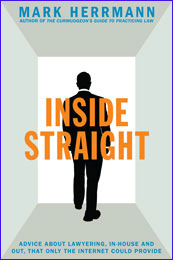
Review: Inside Straight by Mark Herrmann

For those of you that don’t know, Inside Straight is a column over at Above the Law written by Mark Herrmann.  Hermann is a former BigLaw partner at Jones Day, former blogger at Drug and Device Law, and author of the terrific Curmudegeon’s Guide to Practicing Law. He is now chief counsel for litigation at insurance behemoth Aon, having elected to go in house.

Many of his posts from Above the Law have now been collected in a book format. Given that the focus of the book is the relationship between the legal departments of large companies and BigLaw shops wooing their business, is it worth reading for the small guy in the personal injury field? If you thought no, you would be thinning wrong.

While much of Herrmann’s substance involves the inner workings of that relationship, I nevertheless find the book engaging. (I’m half way through.) And there is only one good reason for that: He’s a terrific writer.

His ability to engage the reader becomes obvious if you attempt to read some of the Above the Law comments that were excerpted from the web site to go with each column in the book. Leaving aside the trashy nonsense comments for which ATL is (in)famous, I found the those who responded on substance generally bored me. It was only Herrmann’s writing that was of interest.

A sample column had to do with how BigLaw sells itself to inside counsel to get the high paying gigs. Herrmann gave the time honored advice that I learned many years ago, “Show, don’t tell.” Which is to say that persuasion comes from marshaling facts, not pretty  prose.  Telling someone you are a great trial lawyer is one thing; showing them a list of cases you’ve tried and the results is something else.

That advice crosses all lines in sales. Do you want  car salesmen to tell you the car is best in class, or do you want them to compare the mpgs, repair rates, and included widgets to others you might be considering?

Since I deal with insurance companies all the time, I do feel in some sense that I’m being given a behind the scenes look at some of the things that go on, and the politics of various relationships.

Herrmann is a good read, and because the book is a collection of blog posts, the chapters are easy nuggets to chew on at your leisure.