October 27th, 2014

Ebola and the Failure of Lawyering (Updated)

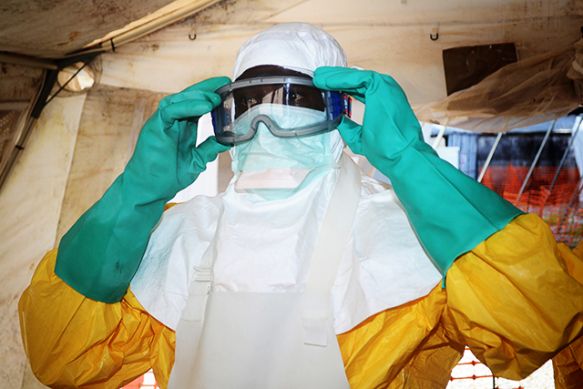
A member of Doctors Without Borders dons protective gear at the isolation ward of the Donka Hospital in Conakry, Guinea, where people infected with the Ebola virus are being treated. (Photo: Cello Binani/AFP/Getty Images)

A member of Doctors Without Borders dons protective gear at the isolation ward of the Donka Hospital in Conakry, Guinea, where people infected with the Ebola virus are being treated. (Photo: Cello Binani/AFP/Getty Images)

Gov. Chris Christie was the US Attorney for New Jersey. Gov. Andrew Cuomo was the Attorney General for New York. You’d think that, with those credentials, they’d be smarter.

Each of them knows that a long view must be taken with respect to many, many issues, often with extensive evaluation of complex issues.  It took them years, sometimes, to accomplish things with litigation.

As lawyers we cite to precedents that go back decades, sometimes centuries. This is part of critical thinking and analysis.

But when it comes to the Ebola virus, they’ve both capitulated to the concept of panic first and think second.

Both governors have now imposed a 21-day quarantine on medical workers who risk their lives to go to west Africa to help save lives and fight the virus. So in addition to an involuntary deprivation of liberty for those now returning, even if healthy, they have  also made the  job of helping more difficult for these particular brands of heroes. If a doctor or nurse was willing to squeeze out a 3-week trip to help, that just became a 6-week trip.

The ostensible reason is to make it harder for the virus to come here. But the result is the opposite.

Instead of fighting the disease where it is, it is now more likely to spread with less medical care. And folks who are visiting the region will simply vanish from sight (and potential monitoring) by routing themselves to other U.S. airports, via other countries, where they won’t be subject to the long arm of government.

Even if we stopped all people and flights, the proliferation of the disease if left unchecked would just as easily go to many a European or Asian nation. It could go anywhere, since disease knows no politics or borders.

Instead of 10,000 infected in Africa, it could grow to 1,000,000 if left unchecked.

The only logical answer is to stop the disease where it is. Does that mean risk that a few people might come back sick? Of course. But a few sick folks here now is a whole lot better than many sick people here later. It isn’t about picking a good course of action over a bad one, but picking the one that is less bad.

We should be encouraging people to help if they have the skills, not discouraging.

The short-sighted plan runs counter to the long-view training both Christie and Cuomo have as lawyers. They should both be embarrassed for their blundering pandering to the ignorant panicers.  The times call for the type of deliberative long-term evaluations and critical thought that they had been trained to do, and they failed.
——————–

Updated: Elsewhere of interest on law blogs:

Experts Debate Legality of New Jersey’s Ebola Quarantine Policy (WSJ Law Blog)

Seized By Fear: The Ebola Quarantine(Simple Justice)

Constitutional challenge to quarantine unlikely to succeed (Volokh Conspiracy)

Which Privacy Protections Apply? HIPAA, FERPA and Ebola (HIPAA, HITECH & HIT)

Ebola and Privacy: Snooping, Confidentiality, and HIPAA (Daniel Solove)


October 10th, 2014

RIP: Prof. David Siegel

siegel_David

Professor David Siegel, from his Albany Law School biography page

Calling Professor David Siegel a giant of the New York legal world would not only be a bit trite, but would still be an understatement. His treatise on New York Practice, the bible of New York civil procedure, is a required text for anyone that works in this state’s courts on the civil side and is routinely cited by judges at all levels, both state and federal.

He died yesterday.

In an obituary at the New York Law Journal, former Chief Justice Judith Kaye is quoted thusly from a 2008 Albany Law School event honoring him:

“Who among us doesn’t know that he is the—absolutely the—preeminent authority on matters of civil practice in the entire universe?” Kaye said at the time. “There’s no one with a bit of good sense who would dare ever to cross you on matters of civil practice, David Siegel.”

Like many other local lawyers, I attended Siegel’s continuing legal education classes regarding our civil procedure many times. And here’s the thing: The guy wasn’t just smart and practical, he was funny.

That humor was reflected not only in his on-stage manner, but incorporated into his New York Practice book. I mean really, who the hell ever laughed out loud at something in a book about legal procedure? But Siegel could pull that off.

On a few occasions in this blog over the years I’ve mentioned that it sucks to be a test case, usually on the subject of our new and untested ethics rules regarding online conduct and solicitation. That mantra of “it sucks to be a test case” comes from Siegel, who used to preach that advice when lawyers would pose factual situations that might (or might not) comply with our procedure.

Ever the practical person, he knew that it wasn’t always whether some procedural issue would work or not, but that lawyers should avoid placing themselves into the position to have to make that decision. You might (or might not) win your test case, but it will cost you time, money and sleepless nights to get there.
——————–

From appellate lawyer Jay Breakstone:

I suppose it’s to be expected.  A lawyer dies and we all gather around and describe him in the most glowing terms, whether he was a saint or a nasty bastard.  Sometimes, it’s like being at Hitler’s funeral.  “All in all, what can we say?  He was a hell of a dancer.”  At the time of death, there is always something nice to say about anyone.

But the recent loss of David Siegel is something else.  It is the true loss of someone we needed, not just admired.  Prof. Siegel was that one tool on the belt of every working lawyer that we couldn’t live without.

He was the Vise-Grip plier that could wrap itself around a particularly nasty question and break it loose from our own ignorance.  And, just like that Vise-Grip plier, he was always there.  Except for now.

To those of us who write about the law, David Siegel had a very unique talent.  The Professor could make the law understandable.  What a gift!  After all, this is not John Grisham writing about steaming plot lines and attractive anti-heroes.  This is New York practice, about as entrancing as a heartburn.  Yet, David Siegel made it sing.

How did he do that?  To this day, I do not know.  In the master’s hands, New York practice was just about the most interesting thing in the world.  It involved real people and real lawyers and real problems and, best of all, real answers.  Like some ancient prophet, Prof. Siegel revealed all that came down from on high to those of us who lived below.

I first came across Prof. Siegel at a bar review course in 1976.  They said that his course on New York practice was essential.  I think I paid extra to take the course and they were right.  He lectured in a style that can only be called “conspiratorial.”  This was a lawyer talking to other lawyers (almost.)

It was him and us against the world.  At last, this was the real thing.  No theories, no big shot federal jurisdictional issues; this was blue collar lawyering at its best.  We listened enraptured, for we quickly understood that if by some slight chance we actually passed the bar exam, this was what we needed to know on the day after our admission. I can still hear David Siegel today:

“One day, as young lawyer, your boss will send you to court.  How exciting!  You will carry the nice new briefcase your parents bought you and head off to the courthouse at 60 Centre Street.  You will walk up the steps with the sun shining, ready to do battle for justice.  You will enter the beautiful lobby and, just as quickly, you will descend into the bowels of hell.  You have been sent to the Special Term, Part I courtroom.

As you open the swinging doors, you will be assaulted by a scene out of Dante’s Inferno.  Hundreds of lawyers will be there, shouting out the name of hundreds of other lawyers.  You will sit down in the back of the courtroom and wait for the judge to take the bench and call your case.  But there will be no judge to hear your application for an adjournment.  Only the clerk will take the bench and he will begin to rattle off case after case in the order they are on the calendar taped to the wall outside the door – – the calendar you did not notice when you came in.  So, you will listen for your case to be called.

Quickly, the case names go by, and then, you think you hear yours!  You walk to the front of the courtroom, only to realize that in the time it took you to make that trip, fifty other cases went by.  There is no one to talk to; you are alone in a crowd, secure in the knowledge that once you get back to the office, you will be fired and have to pack up your desk in one of those cardboard boxes and go home, telling your mother you’re not a lawyer anymore.”

It was then that David Siegel, as he did until the day he died, rode in like a knight on horseback and saved our lives:

“This is what you have to know:  There are only three things you may yell out in Special I.  Nothing else will register in the mind of the clerk.  He or she is only programmed to respond to these three magical phrases.  Write them down now.  Memorize them.  Never forget them.   Here they are:  Ready for;  Ready against; Application.”

Prof. Siegel, I have never forgotten those words . . . or any of yours.